

The problem with most kitchen layouts isn’t that they’re wrong. It’s that they don’t really hold up once you start using the space the way you actually live in it. Maybe you’re prepping and something’s going on the stove and someone cuts across to grab something from the fridge. It doesn’t seem like a big deal but it is enough overlap to slow everything down.
The traditional triangle layout is built around one person moving between the sink, stove, and fridge. Works fine until the kitchen has to handle more than that.
Zoning comes out of that home improvement. Instead of pulling everything into the same working area, a kitchen renovation built around zones spreads things out by task (prep, cooking, cleaning, storage) so you’re not constantly working around each other.
How Zoning Changes the Way a Kitchen Works
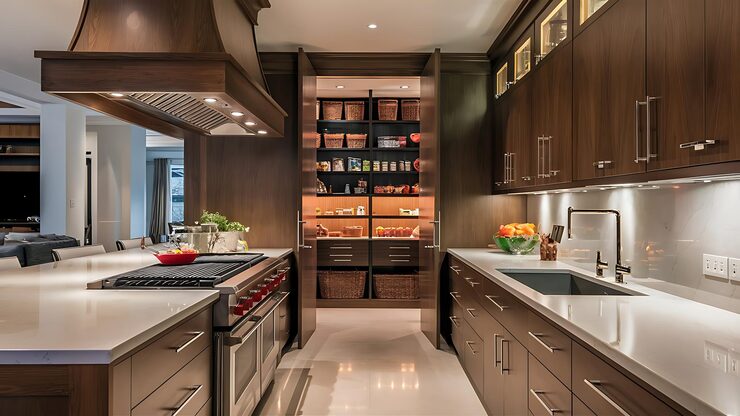
In a typical layout, everything you do keeps pulling you back into the same stretch of space. You move between tasks, but so does everything else. With zoning, that stops happening as much and that’s usually the shift people notice first in a kitchen renovation built around it.
This way, you’re not stepping into the same area for prep, then back again for something else, then adjusting because someone’s already there. The kitchen starts holding those tasks where they belong. It has dedicated space for prep, where you’re working; cooking, where it’s centred, cleaning where it stays contained.
So instead of moving through the same few points again and again, you stay within what you’re doing. It feels like less movement but it’s really fewer interruptions. And that’s where the difference starts to show.
What Zoning Changes in Practice
- You stop restarting tasks midway. In a kitchen renovation designed around zoning, the idea is that you stay with what you’re doing instead of constantly breaking your rhythm to make space for something else.
- The kitchen can handle more than one person at a time without turning into a constant shuffle for space. That’s why a lot of modern kitchen designs are moving away from single-path layouts and towards separated working areas that can operate side by side.
- Clutter doesn’t take over the entire bench the way it used to. It stays closer to where it starts and the workspace doesn’t slowly collapse into one crowded surface.
- You don’t keep moving back and forth across the same areas for simple tasks. A well-planned kitchen renovation reduces that back-and-forth by placing things where they’re actually used instead of forcing every task through the same points.
- It feels calmer even when it’s busy, because everything isn’t happening in one tight stretch of counter space. The activity is still there; it’s just distributed in a way that feels easier to manage.

FAQs
-
What is a zoned kitchen renovation?
A zoned kitchen renovation is a layout approach where the kitchen is organised into specific work areas like prep, cooking, and cleaning instead of relying on one shared triangle. The idea is to separate activities so they don’t constantly overlap in the same space.
-
Is zoning better than the traditional kitchen triangle?
It depends on how the kitchen is used. The triangle works well in smaller or single-user kitchens, but zoning becomes more useful when multiple people are using the space or when daily activity starts overlapping and slowing things down.
-
Do modern kitchen designs use zoning?
Yes, many modern kitchen designs are moving towards zoning because it reflects how people actually use kitchens today. Instead of focusing only on distance between points, it focuses on reducing interruptions and improving flow during real use.
-
Can zoning be included in any kitchen renovation?
Yes, zoning can be adapted to most kitchen renovation projects, regardless of size. It’s not about making the space bigger, but about planning placement so each activity has a clear, functional area within the layout.
Summing Up
A zoned kitchen renovation is not a big visual change on its own, but it changes how the space works once you start using it every day. Instead of everything revolving around a single working triangle, zoning allows different tasks to sit in their own areas so movement feels more natural and less interrupted.
It does not replace the basics of a good layout. It simply handles the parts that become clear only when the kitchen is in use, especially when more than one person is working in the space at the same time.
If you are planning a kitchen renovation that feels more practical in real life rather than just on paper, we can help. At Hills Robes and Kitchens, we design kitchens that work the way you live.